Jamala Rogers: Remembering Alice Windom
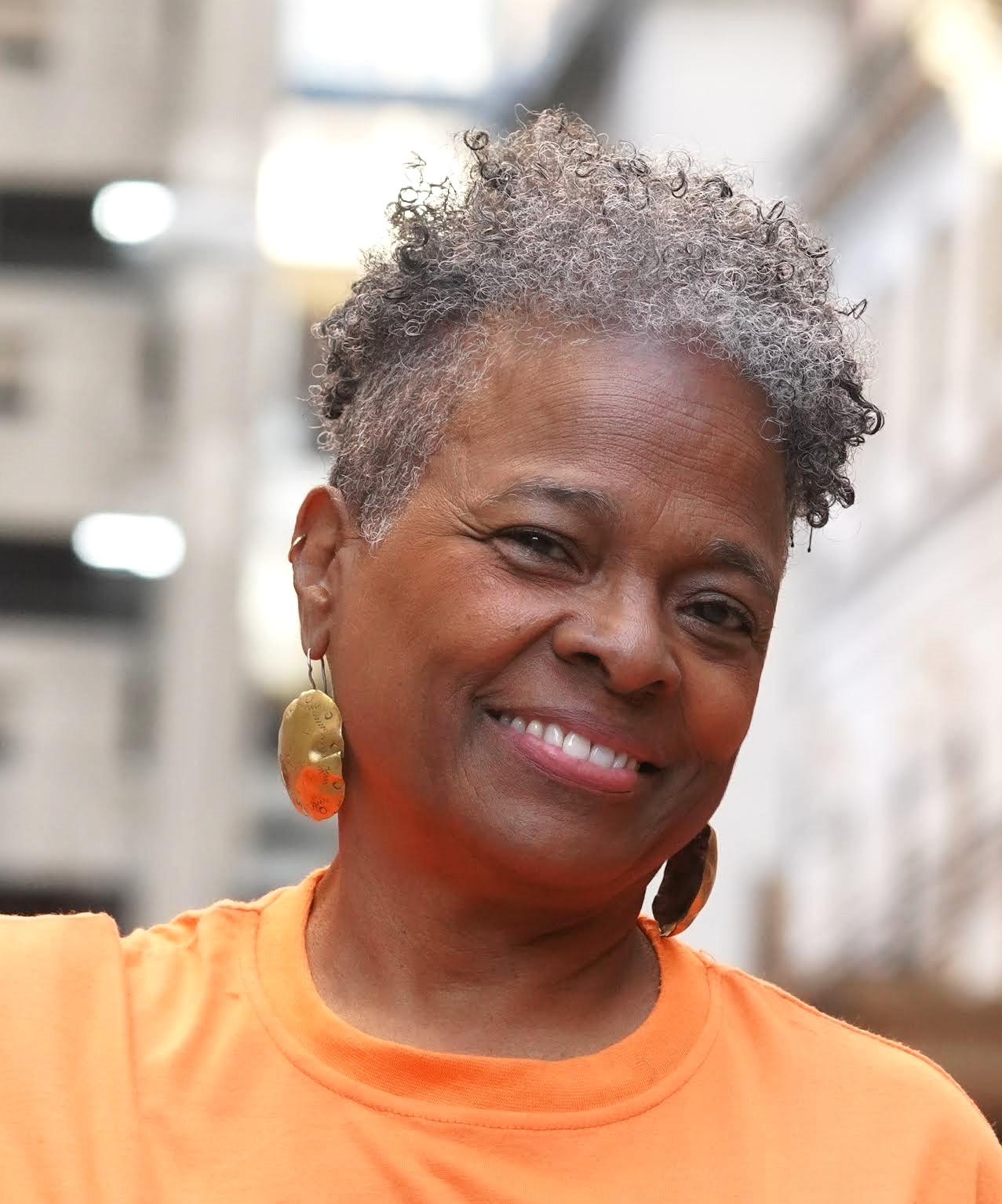
Jamala Rogers is a St. Louis-based activist, organizer, feminist, and political strategist with deep roots in the Black Liberation Movement. She has been committed to racial justice and educational reform in St. Louis since the 1970s. She is a founder and former Executive Director of the Organization for Black Struggle (OBS). Established in 1980, OBS is a group of veteran activists, students, union organizers, and community members seeking to address the needs and issues of the Black working class in St. Louis. Jamala Rogers often found herself working in the same community spaces as Alice Windom, often in parallel activist organizations committed to similar goals. Alice Windom was active in the St. Louis Committee on Africa. At the same time, Jamala Rogers was a founding member of the St. Louis Chapter of the Congress of African Peoples and an active member of the National Black Political Assembly. Alice Windom was an active member of the St. Louis National Association of Black Social Workers. Jamala Rogers is a featured columnist for the St. Louis American, and her work often appears in the Black Commentator and Capital City Hues. She has written articles for local and national publications and is the author of "Ferguson is America: Roots of Rebellion." 
Jamala 35 Edits

Interview conducted at the Rowan Community Center and Foundation, Organization for Black Struggle, 1401 Rowan Ave, St. Louis, MO 63112 on Thursday, April 29, 2025.

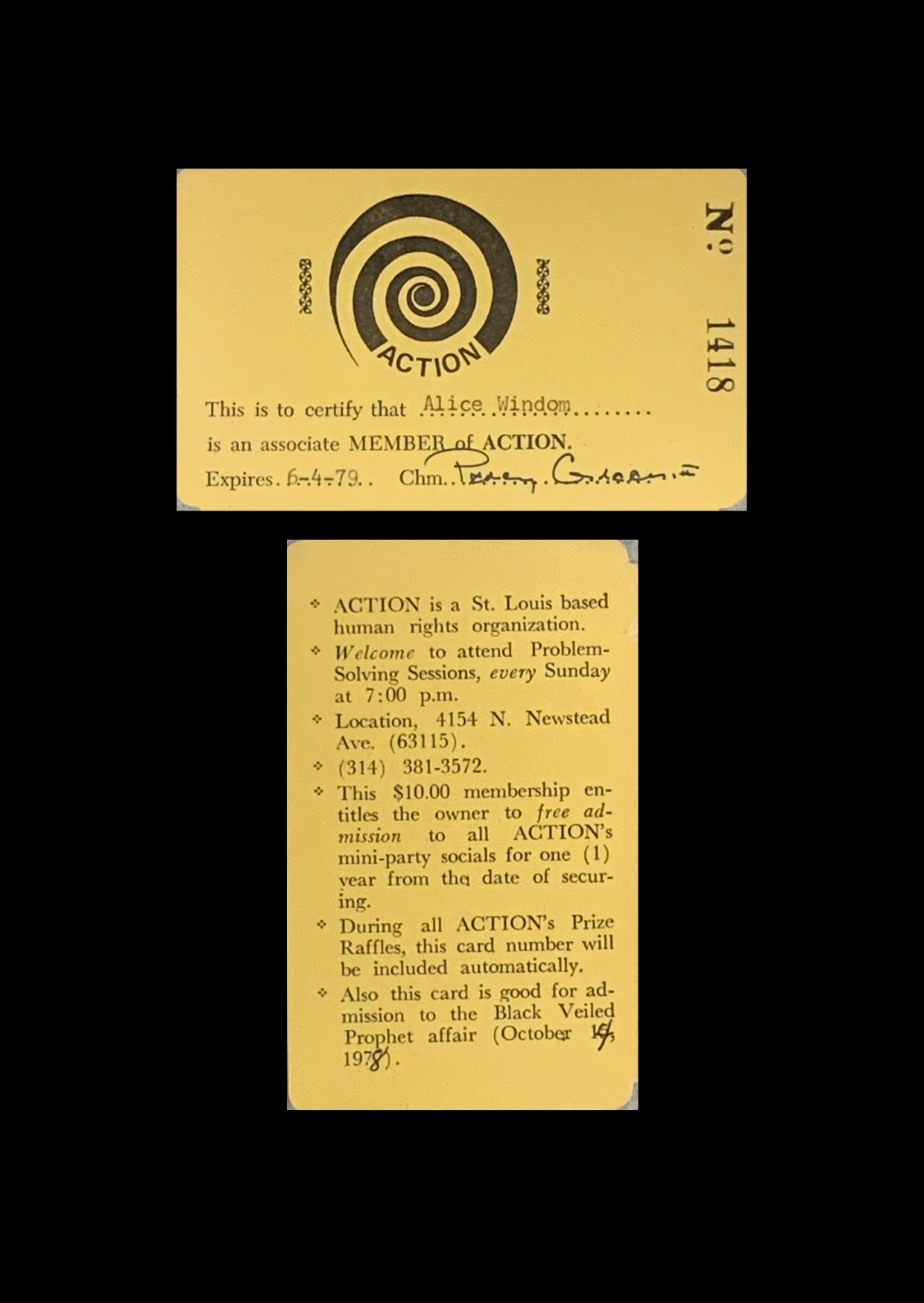
Alice Windom's ACTION Membership Card

Alice Windom's Action Membership Card, June 1978 - June 1979. From the Griot Museum of Black History, Alice Windom Collection.

I just remember her being ever present, you know, around these things, and that you could always expect to see her at certain events, so you could expect to see her at the anniversary celebrations for the Organization for Black Struggle, you could expect to see her at the Coalition of Black Trade Unionists.
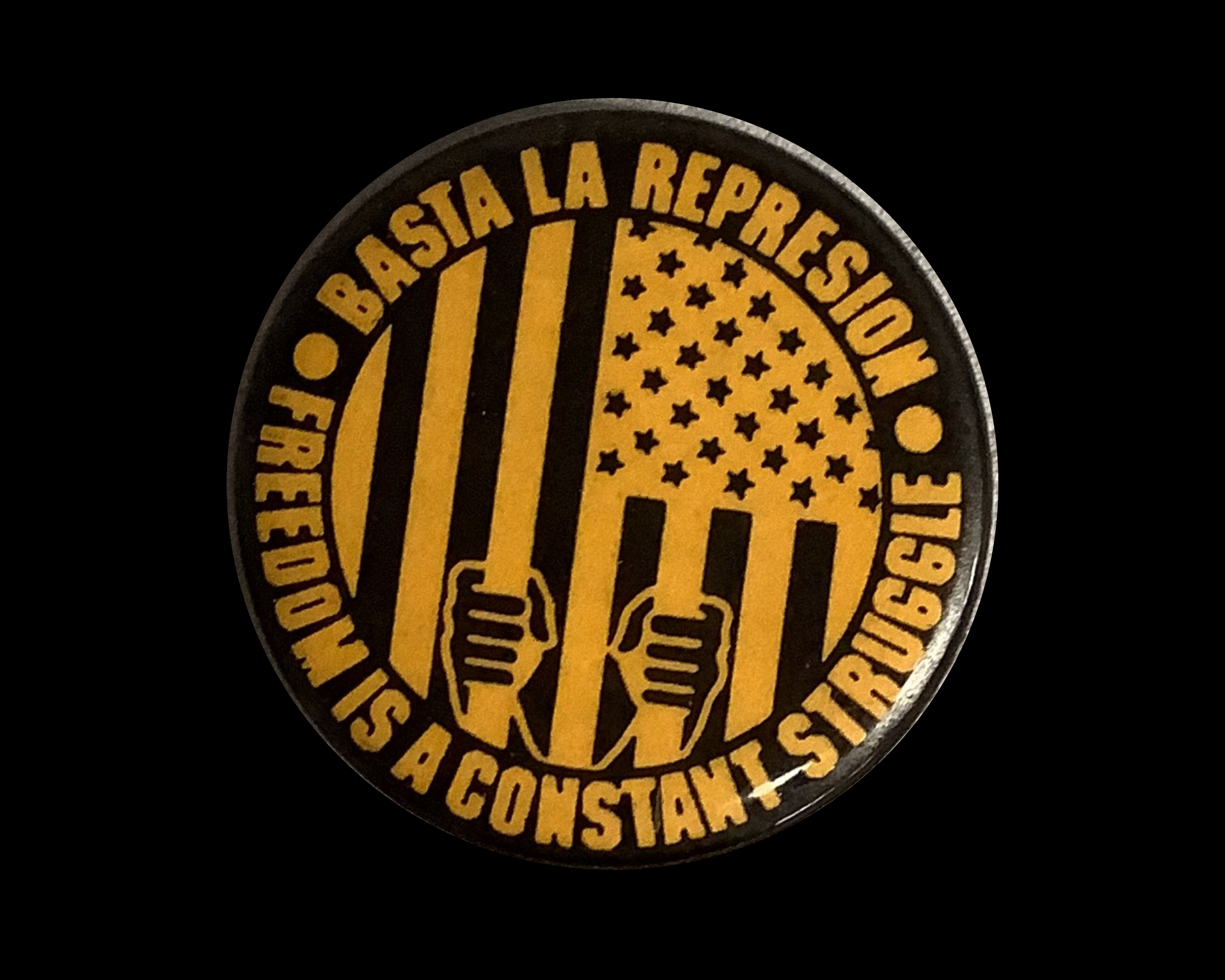
Issued by the National Alliance Against Racist and Political Repression, depicts the logo for the Chicago Alliance Against Racist and Political Oppression. The design in yellow and black depicts the American flag turned vertically, representing prison bars. Hands grip the bars near the botton of the design. The text in yellow reads Basta La Represion [Enough Represion) Freedom is a Constant Struggle.
1 3/4 inch round, metal button with pin back.

Basta La Represion Freedom is a Constant Struggle, 1 3/4 inch round button/pin. From the Griot Museum of Black History, Alice Windom Collection.

I think for people like myself and Alice Windom, that's what we've been trying to do with our lives, to leave those lessons, to participate in events, activities, that are projecting the self-determination of Black folk, but also the democracy here in the spaces where we're going to be living, and ultimately the nation.
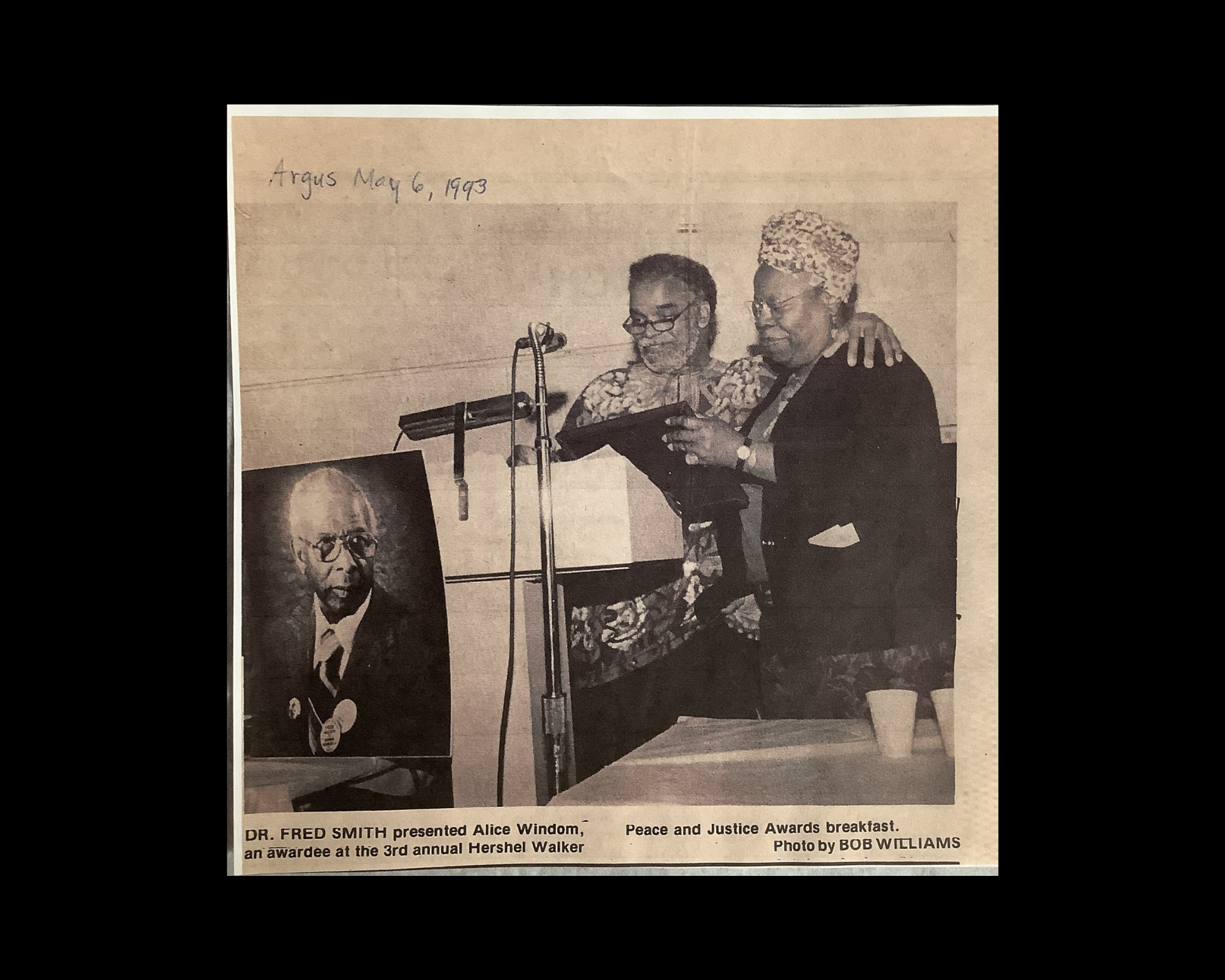
News clipping of image of Alice Windom and Dr. Fred Smith.
Caption: Dr. Fred Smith presents Alice Windom an award at the 3rd annual Herschel Walker Awards.

Dr, Fred Smith presents Alice Windom with a Hershel Walker Award. 1993, From the Griot Museum of Black History, the Alice Windom Collection. 

And I saw that, like I said, throughout all of the Windoms, their passion for education, their love of learning. In fact, that's one of the principles of the Community Education Center was lifelong learning. And I'm very attracted to that notion, because I do believe learning is lifelong, and you have to be a learner as long as you're breathing, so that you continue to evolve as a human being in the space that is actually anti-Black and anti-human in many ways, and so that obstacle, you have to learn how to transcend that, so that you can be a whole, human, healthy, sane person.

I think she was most proud of her Pan-Africanist experience. Her work with countries that were fighting for liberation and understanding that's what folks in this country, some of us, were fighting for, on a different level...So, being in the nexus between Africa and the US and making a bridge of those peoples and being in company with the other folks who were doing that, because that's certainly what Malcolm X was doing. He was moving that relationship between Africans here, and Africans abroad.


“The possibility of reconnecting with allies from her New York community clearly fueled Garvin’s attraction to Ghana, and she soon decided to stay on in Accra. Garvin settled into sharing a house with two other single African American women, Alice Windom and Maya (Angelou) Make. All three women could be counted among the group of African American expatriates with a history of association with the U.S. black left. These activists, generally in their thirties and forties, became known in Ghana as the “politicals” of the Afro-American set.” - Dayo F. Gore
< Previous page Next page >